Quick Alternate Histories: A Post-Beringia Pre-Columbian Migration
 |
| famed illustration of smallpox in Mexico |
In the best alternate histories, the "hinge factor" - or the agent that changes everything - is relatively small and easy to accept as plausible. For this situation, I'll admit it's a little more difficult to imagine - but we're going to do it anyway.
 |
| early human migrations (source) |
Smallpox is thought to have appeared in humans about 10,000 years ago - too late to have been brought to the Americas by way of Beringia. Rinderpest, which also gave birth to measles, appeared sometime before 5,000 years ago in China, influenza symptoms were clearly described 2,400 years ago, and cholera likely came about a few thousand years ago also, in India. While the first Americans also experienced disease, they would have had to experience many of the same diseases as Europeans in order to have avoided the "great dying" that went on from the 15th through 19th centuries.
 |
| currents (source [ppt]) |

This would have given the Americas about a millennium and a half before the era of European exploration for new bacteria and viruses to multiply, spawning misery as well as resistance and immunity. Certainly, these new American diseases would not have been the same as those brought by Columbus and his successors, but coming from Japan (part of the Afro-Eurasian disease pool) they may have been much more similar, and indeed, if Europeans had experienced more deadly diseases when they arrived in the Americas, colonization or "conquest" would have been much more difficult. Not only would Native American societies have avoided such massive destruction due to novel strains of disease, (in many cases 80-90% mortality), but Europeans would have had a much harder time settling on the other side of the Atlantic if significant percentages of would-be colonists died due to American diseases.
Had Native Americans been exposed to new Afro-Eurasian diseases from a post-Beringia pre-Columbian migration, and had the diseases brought by Europeans from the 15th century onward been less devastating in their impact, the history of the entire world would have been massively different. Europeans would have still come to settle and exploit the lands they had just discovered, but their experiences would have not at all been what we're familiar with: Gone would be the glorious victories of Cortes or Pizarro, and settlers like the pilgrims would not have had so much "elbow room" upon arrival.
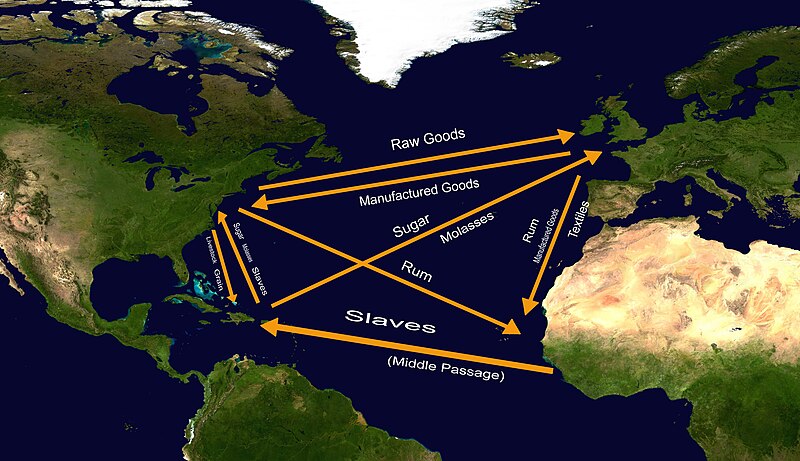 |
| trans-Atlantic trade (source) |

This is the second post in my "Quick Alternate Histories" series, and yet again I have utterly failed to make it "quick," making a mockery of my series title. (Be sure to check out the first QAH: "A Franco-German Empire.") The whole point of this, though, is to show how fun it is to imagine changes in history, and I've definitely proven that by carrying on and on in my writing. Remember, alternate histories are thought-exercises that prove how accidents and circumstances beyond our control have shaped (and continue to shape) how we live, where we live, and who we are. Had all the crazy possibilities I mentioned in this post occurred, you and I would almost certainly not exist.
Comments
Post a Comment
Thank you for your comment!